
It’s easy – tempting, even – to break sports down into a two-row column. Wins and losses. X’s and O’s. Production or failure.
Success in athletics is dictated by the bottom line, and athletic director Patrick Nero knows this tenant holds value. Closing his first full year in office, he will have seen a new school record of five championships, four Coaches of the Year and the implementation of a comprehensive athletics strategic plan.
But there’s another side of athletics that Nero considers crucial – the network of support that links members of each sport, pulling them tightly together to weave a family.

The strategic plan was born from a comprehensive, yearlong athletics review, one showing that a boost in athletic success needed to start with an increase in the support each program received from the University. Some of that aid comes in the form of finances, an uptick in budgets designed to push GW’s operations and facilities to the highest tier of the Atlantic 10. Another huge chunk of that support, Nero said, is underlining the familial feel of the athletic department. It’s about taking to the sidelines to support one another, athletes, coaches and administrators alike.
Essentially, he said, it’s about combining those efforts – the money, the coaching, the facilities, the support – to rebuild an athletics program “the right way.”
“We heard it best from the golf team, [who won the A-10 championship this year] when we said, ‘What was the difference?’ And they said, ‘People were paying attention. People cared. We knew that we had a community at GW that wanted us to win,’” Nero said. “And they maybe didn’t feel that before.”
Three coaches at three distinct points in their respective teams’ histories each emphasized the same characteristic about their boss: his desire to build programs without shortcuts.
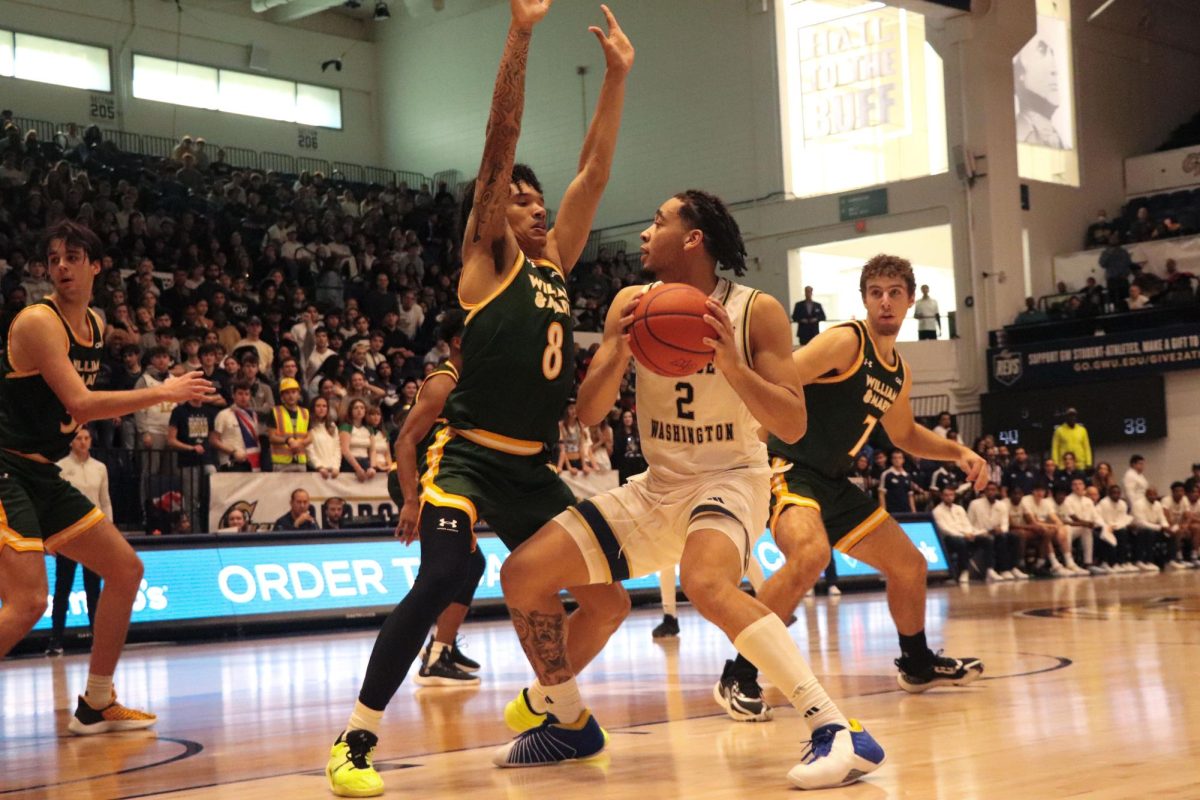
Ten wins and 21 losses was not the record men’s basketball head coach Mike Lonergan wanted. Still, he said, the program is “doing things the right way,” focusing on recruiting, the chief metric Nero said the men’s basketball program will be evaluated on over the next few seasons.
The athletic director isn’t “for a quick fix,” Lonergan said, pointing to Nero’s support of an increase in schedule strength and an upcoming trip to Italy as two significant changes for a rebuilding program. Lonergan likes coaching at a school where he feels “like things are headed in even more of a positive direction,” where he can see the support extended to his program applied across the board to the University’s athletic teams.
“Just sitting in on meetings with Patrick Nero, seeing the coaches on other sports, their eyes lighting up when he’s talking about different initiatives and things,” Lonergan said. “I really like when all the sports are treated fairly and well.”
One townhouse over from Lonergan’s office, Jonathan Tsipis is settling into his new role as head coach of the women’s basketball program. He too has been charged with turning a marquee University team around, restoring it to its former heights.
Some of the qualities that drew him to GW, Tsipis said, were Nero’s emphasis on academics and his desire to create a unified athletics community that stretched beyond individual teams.
Since his arrival, Tsipis has been impressed with Nero’s insistence on rebuilding programs “the right way.” Tsipis was given relative leeway to build his staff, he said, with the understanding that it would reflect his and the University’s values.
“He listened to what my philosophy was, and I think it matched, very much, what his vision was,” Tsipis said. “A big part of it was, [Nero said] ‘I want you to build a program that fits you.'”
The coaches who are not new to the University also see the changes Nero has wrought. Craig Jones is preparing to take to the pitch as head coach of the men’s soccer team, after time spent on the field as a Colonial and on the sidelines as one of the team’s assistant coaches, including last season, when GW took a trip to the A-10 title game.
The journey, Jones said, was permeated by shades of Nero’s new administration. A revamped focus on nutrition and off-the-field training – “Since Patrick’s come in, even I’ve been careful of what I’m eating these days,” Jones joked – paid dividends in competition. For example, he added, the Colonials scored more goals late in the games this year, a clear sign of increased stamina throughout play.
It was a sign of the department’s determination to “win the right way,” Jones said. The new athletic director’s arrival, after the retirement of Jack Kvancz, gave the department a jolt of energy, Jones said.
“I think that was the biggest thing you see, someone on the end of a great career going out the door and someone barging through the door, making some positive changes for the whole department,” Jones said.
Steve Hadley runs GWHoops.com, a men’s basketball-focused message board that saw over 60,000 page views in May, a number he said triples during basketball season.
His website is arguably the most comprehensive source for GW basketball, filled with threads that break down players, coaches, teams and recruits into the most detailed minutia. But the 1994 graduate admitted that as time has passed, even he’s begun to lose interest in attending games at the Smith Center, his connection to the team faltering.
But Nero, Hadley said, represents a new era “that may push GW sports ahead again.” The athletic director’s first year established his tenure as “more business-oriented and driven” than regimes past, Hadley said, though it will eventually come down to “noticeable progress and, ultimately, winning.”
“If I wasn’t a Colonial, it would be interesting to sit back and study how a non-BCS school with the means to make things happen navigates this unknown college sports landscape and to what degree they are successful,” Hadley said. “GW has a very unique set of variables which may or may not succeed in the business of college sports.”
Connecting to fans like Hadley is a priority outlined in the athletics strategic plan and in Nero’s vision for the restoration of the athletics program.
Ultimately, the strategic plan aims to put the athletics department’s operating budget among the top of the Atlantic 10. A large chunk of incoming funds, Nero hopes, will come from donations and fundraising.
A new subset of the athletics department dedicated solely to athletics development and the growth of sustainable giving was created this year, looking to start fundraising in the upcoming fiscal year.
The department has set a goal of $1 million in fundraising dollars for fiscal year 2013, after seeing a 12.5 percent increase this year as of May 31. A Buff and Blue Fund will launch for the upcoming fiscal year to boost unrestricted annual giving.
“From a budgetary standpoint, it’s year one. From facilities and other things, it’s year two,” Nero said. “I think what we’re seeing right now, and this is not a secret, is we’re seeing it have a very positive impact on recruiting. The facility upgrades, the money we’re putting into television, a little bit more aggressive marketing.”
Those improvements, and Nero’s commitment to bringing in the funds necessary to raise GW’s level of competition, speaks to the fan base, alumnus Bob Poogach, who graduated in 1973, said.
Poogach, a frequent poster on GWHoops.com, is the sort of fan that embodies the support Nero hopes to one day see across a broader audience. A vocal proponent of all of the intercollegiate athletics programs, he estimates he went to between 40 and 50 GW sporting events this year.
Nero appears to be an “energetic, demanding and supportive A.D.,” Poogach said, one who’s made a name for himself among fans as a dedicated worker.
“They’re serious about raising the level of competition at GW. And so it’s not just, they have a nice little booklet, they call it the strategic plan, and you tend to get a big yawn, because everybody goes through these things periodically,” Poogach said. “But clearly, he’s come in and he’s kind of the embodiment of that.”
Nero estimates he attended 150 GW sports competitions this year. Right before the stretch of weeks that saw first men’s tennis and then men’s golf claim A-10 titles, he bought a house where his belongings sat packed in boxes, as he traveled to watch his programs contend for championships.
His visibility made a lasting impact on the Colonial student-athletes. And in addition to his physical presence, Nero spearheaded inclusive events for athletics programs, like a trip to George Washington’s Mount Vernon estate that gathered all student-athletes in one place for the first time.
Cross country senior Alex Dadds, the incoming Student-Athlete Advisory Council president, served as SAAC’s A-10 representative last year and worked closely with Nero to create the Georgey Awards. They celebrated the successes of teams at the end of the year, and Nero called it the “highlight” of his year in office.
For Dadds, the awards ceremony was when he “really realized [Nero’s] here for us.”
“Just seeing Patrick involved in so many different things with the student-athletes, that was one thing that was missing, and there’s an obvious refocusing taking place amongst all the athletes as a result of Patrick’s dedication to his job,” Dadds said.
The changes aren’t complete, Nero said. Next year, the athletics department will implement a minimum community service requirement for all student-athletes, making GW the first University in the country to take such a measure.
The athletic director has also stood at the front of other change-rippling decisions in his first year.
He saw eight head coaches enter the department, including Lonergan, who replaced Karl Hobbs in a weighty decision that came quickly after Nero’s hire. Three of those eight were fired, a sign of the athletic director’s need for productivity.
The overhaul has an underlying message: Nero knows what he needs for a program to be successful. But, Nero said, those coaching departures ultimately resulted from his responsibility to support the athletes.
“Whether I’m nervous, or I’d rather not do it, or rather not face the media or have to take criticism for it, I can’t not make that decision,” Nero said. “I’m the type of person, if I think it’s the right decision, I’ll make it.”
July 1 will mark the completion of Nero’s first year – one of unprecedented change for the athletics department, and one that indicates further metamorphosis down the road.
Ironically, Nero shies away from describing what changes he thinks bear his personal stamp. It’s not really about him, Nero likes to say. He is just trying to enable the members of each athletics program to create their own impact.
“I want, at some point in the four-year window, or the five-year window, each of our student-athletes to feel like they’ve left their mark on the program,” Nero said. “I want that for every one of our student-athletes.”